Editorial | Monday, June 29, 2026.
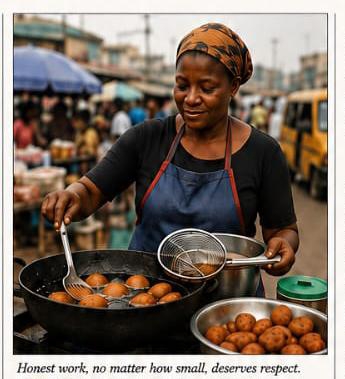
The First Lady, Senator Oluremi Tinubu, encouraged Nigerians to explore small-scale businesses such as selling akara, kuli-kuli, roasted corn, and similar ventures as pathways to economic empowerment.
There is absolutely nothing wrong with that message other than an honest piece of counsel taken out of context.
Across Nigeria, countless families have been sustained through these very enterprises.
Many successful entrepreneurs started with little more than a tray of akara, a bowl of kuli-kuli, or a roadside stand. Honest labour, regardless of its size or scale, deserves respect and recognition.
Yet the reaction from Nigerians reveals a much deeper conversation.
The public is not ridiculing akara or kuli-kuli. Rather, many citizens are expressing years of frustration over an economy that has become increasingly difficult to navigate and survive in.
Graduates spend years searching for employment opportunities that never come. Skilled artisans struggle under the weight of rising material costs.
Small business owners contend daily with soaring fuel prices, expensive transportation, unstable electricity supply, inflation, and declining purchasing power.
For many Nigerians, the issue is not the dignity of selling food by the roadside.
The question is whether that has become the highest aspiration our leaders can offer millions of citizens.
Ironically, even these so-called “small businesses” are no longer small in terms of start-up costs. The prices of beans, cooking oil, groundnuts, pepper, charcoal, transportation, rent, and other essentials have risen sharply in recent years.
Starting an akara or kuli-kuli business today requires determination, resilience, planning, and capital that many struggling Nigerians simply do not possess.
This is why the national conversation must move beyond the businesses themselves.
True empowerment is not merely encouraging citizens to survive. It is creating an economy where survival is no longer the ultimate goal of an economy where people can dream bigger, build thriving enterprises, employ others, and improve their quality of life.
Nigerians are not asking for handouts but for opportunities.They want an environment where education leads to employment; where businesses can grow without being strangled by inflation; where innovation is rewarded; and where hard work produces meaningful progress.
There is honour in frying akara. There is pride in making kuli-kuli.
There is dignity in every honest trade. However, there should also be hope that the next generation will inherit opportunities greater than those available to the last.
A nation should not build its future on survival alone.
As a new week begins, perhaps the real challenge before Nigeria is not whether citizens should sell akara or kuli-kuli.
The crux of the matter is whether our policies are creating a country where such businesses can flourish—and where citizens also have the freedom to dream beyond them.
Empowerment should not merely help people make a living. It should help them build a future.
That is the Nigeria millions are still waiting for.

Good